

Default Backtests Weren’t Enough — So We Decided to Test the Inca/Maya Phenomenon Live
The cTrader Store has just crossed its first year milestone.
In that time, it has grown to more than 2,000 products — and now reached another important benchmark: the first seller to surpass 300 sales.
What makes this case especially interesting is that around two-thirds of those sales came from just two Gold trading bots: Inca Gold Grid and Maya Gold Grid.
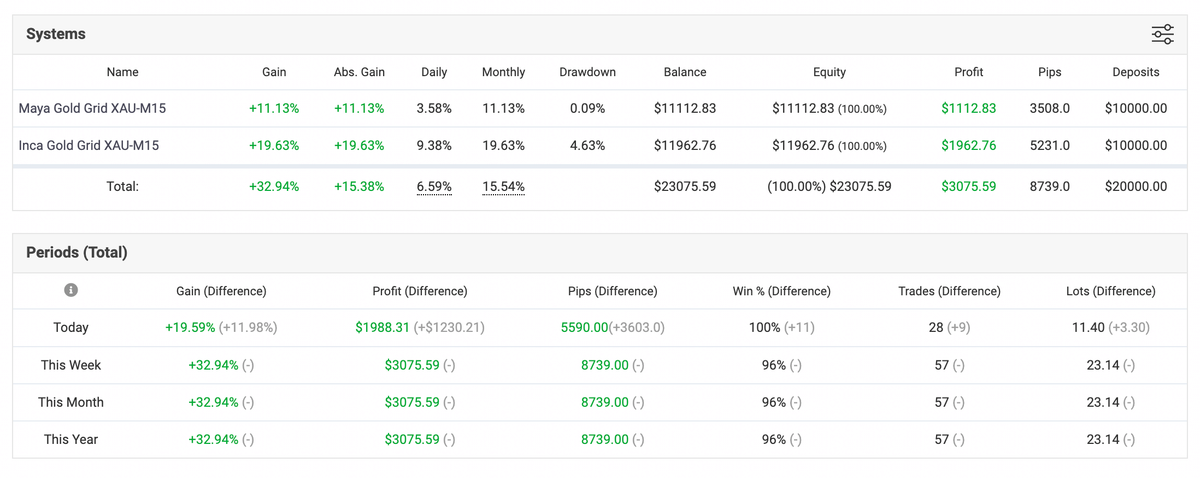
Live results Inca and Maya.
Our Inca and Maya setups. (how to upload)
For us, it became something more interesting: an attempt to investigate the Inca/Maya phenomenon.
Basic 10 rules for working with trading bots.
How to backtest. How to optimize. How to upload bot setup.
- Default settings are rarely the best settings.
Use them only as a starting point, then optimise the bot on a demo account with your broker. - Broker conditions matter.
Spreads, commissions, execution speed, and symbol specifics differ from broker to broker, so always run your own backtests. - Start with demo, not live.
Before risking real money, check how the bot behaves in real market conditions on a demo account. - Gold is highly sensitive to political and macro news.
XAUUSD can become extremely volatile around major headlines, so be extra careful with risk settings. - Disable Gold bots before weekends if needed.
Weekend gaps and unexpected geopolitical events can create dangerous conditions when the market reopens. - A bot is a tool, not a money button.
Even a strong algorithm still requires monitoring, validation, and risk control. - Never copy settings blindly.
Use shared setup files as a reference point, not as a universal solution. - Re-optimise from time to time.
Market conditions change, and a setup that worked well before may need adjustment later. - Use risk you can actually afford.
Grid systems can be effective, but they require disciplined position sizing and capital management. - Watch live behaviour, not just backtests.
A historical curve may look nice, but real confidence comes from forward testing and live observation.
Why Have Traders Trusted These Gold Bots with More Than $100,000 in Live Capital?
That was our starting point.
We were not fully satisfied with the default backtesting picture. On Gold, a standard backtest often shows only part of the story: volatility regimes change quickly, and broker-specific execution can make a real difference. So instead of stopping there, we decided to go further — re-optimise the strategies, launch them live, and observe how an ATR-based grid system performs in the current high-volatility market environment.
We are also sharing the exact configuration files used for our current Maya and Inca runs — not as something to copy blindly, but as a reference point for traders who want to study the setup, adapt it, and test it properly on their own broker.
Live results Inca and Maya.
Our Inca and Maya setups. (how to upload)
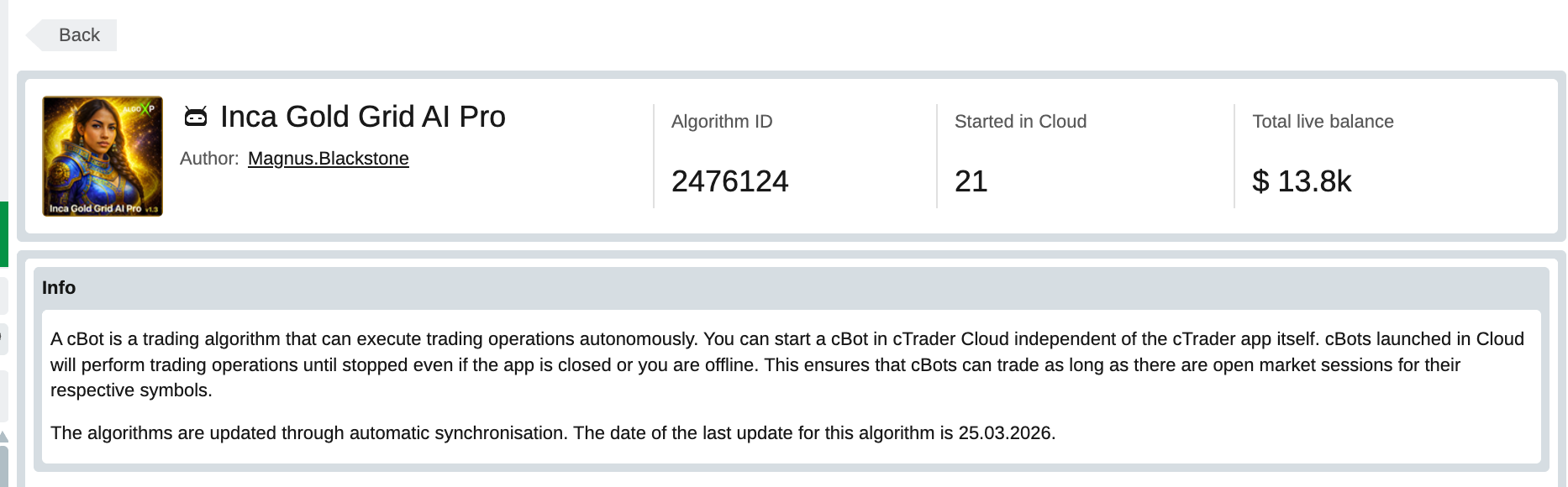
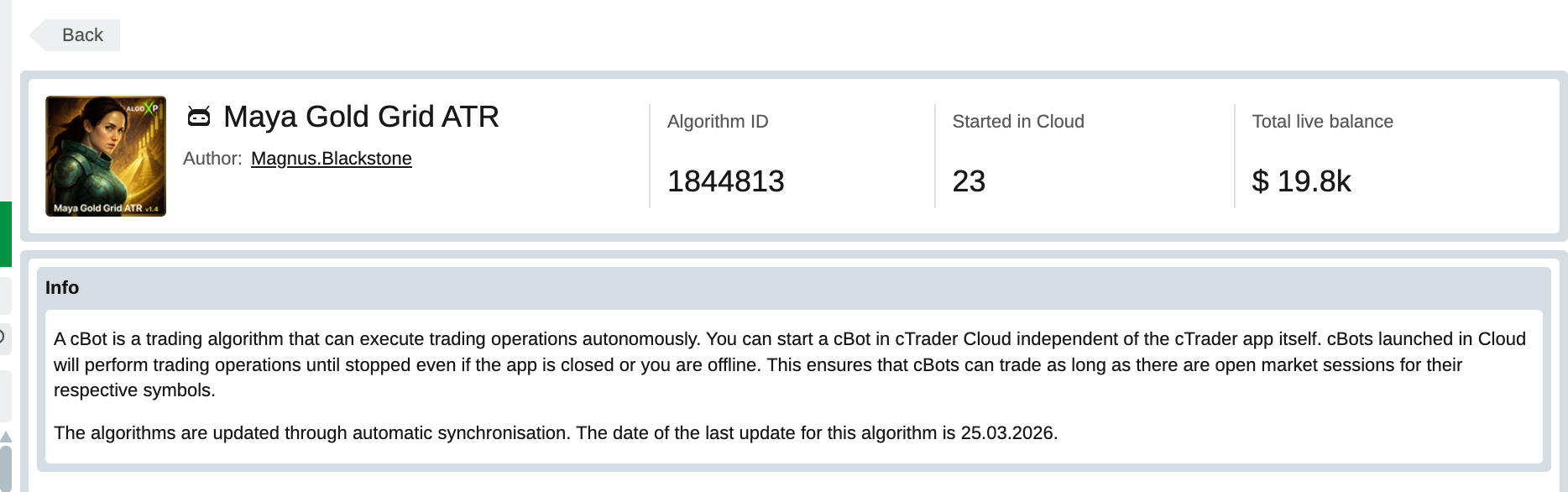
Another reason this case stands out is the level of trust behind it. In the Algo section, you can already see meaningful live capital allocated to these bots in cTrader Cloud alone: roughly $19.8k for Maya and $13.8k for Inca at the time of writing. And that is only the cloud side. Based on local launches as well, the real figure is likely several times higher.
In practice, these bots are operating on more than $100,000 of live capital at a given moment.
That level of trust is exactly why we decided this case deserved a closer look.
A seller milestone — but not a one-product story
Although Inca and Maya account for most of the sales, this is not a one-hit case.
The seller’s portfolio also includes a EURUSD bot and several popular indicators, which helps explain why this milestone matters. It suggests that traders are not just reacting to a lucky product page or a short-term wave of attention. They are engaging with a broader body of work from the same author.
That is often how trust is built in algorithmic trading marketplaces.

.png)

Why ATR-based grid logic gets attention on Gold
At the core of Maya is an ATR-driven adaptive grid approach.
That matters because Gold is not a market that behaves at one speed. It constantly rotates between calm consolidation and aggressive expansion. Fixed grid spacing in this kind of environment can become fragile fast. Too tight, and the system can get trapped in noisy movement. Too wide, and it can miss the structure of the market entirely.
ATR — Average True Range — offers a more adaptive way to think about that problem.
Instead of forcing the market into static parameters, the grid adjusts to current volatility conditions. When price action expands, spacing can widen. When the market is quieter, spacing can tighten. In theory, this allows the strategy to remain more responsive across changing regimes without being overfit to one exact moment in history.
That does not mean ATR is magic.
It does not eliminate risk.
And it definitely does not make Gold “easy.”
But it does make this type of strategy worth studying, especially in a market environment where volatility is being driven not just by technical flows, but by macro headlines, geopolitical tension, and sharp sentiment shifts.
That is exactly the kind of environment we are testing in now.
From theory to live observation
This is where our investigation became more practical.
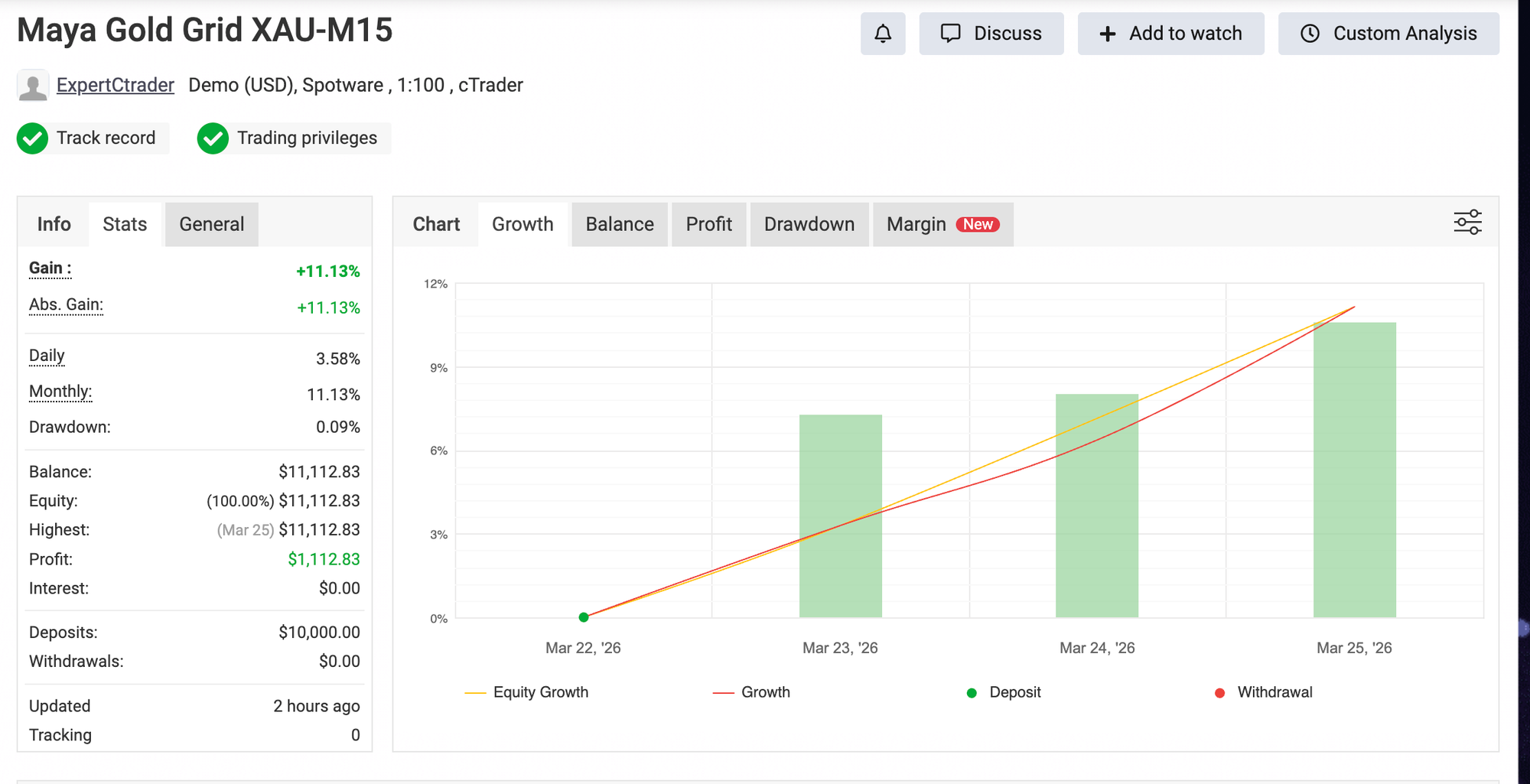
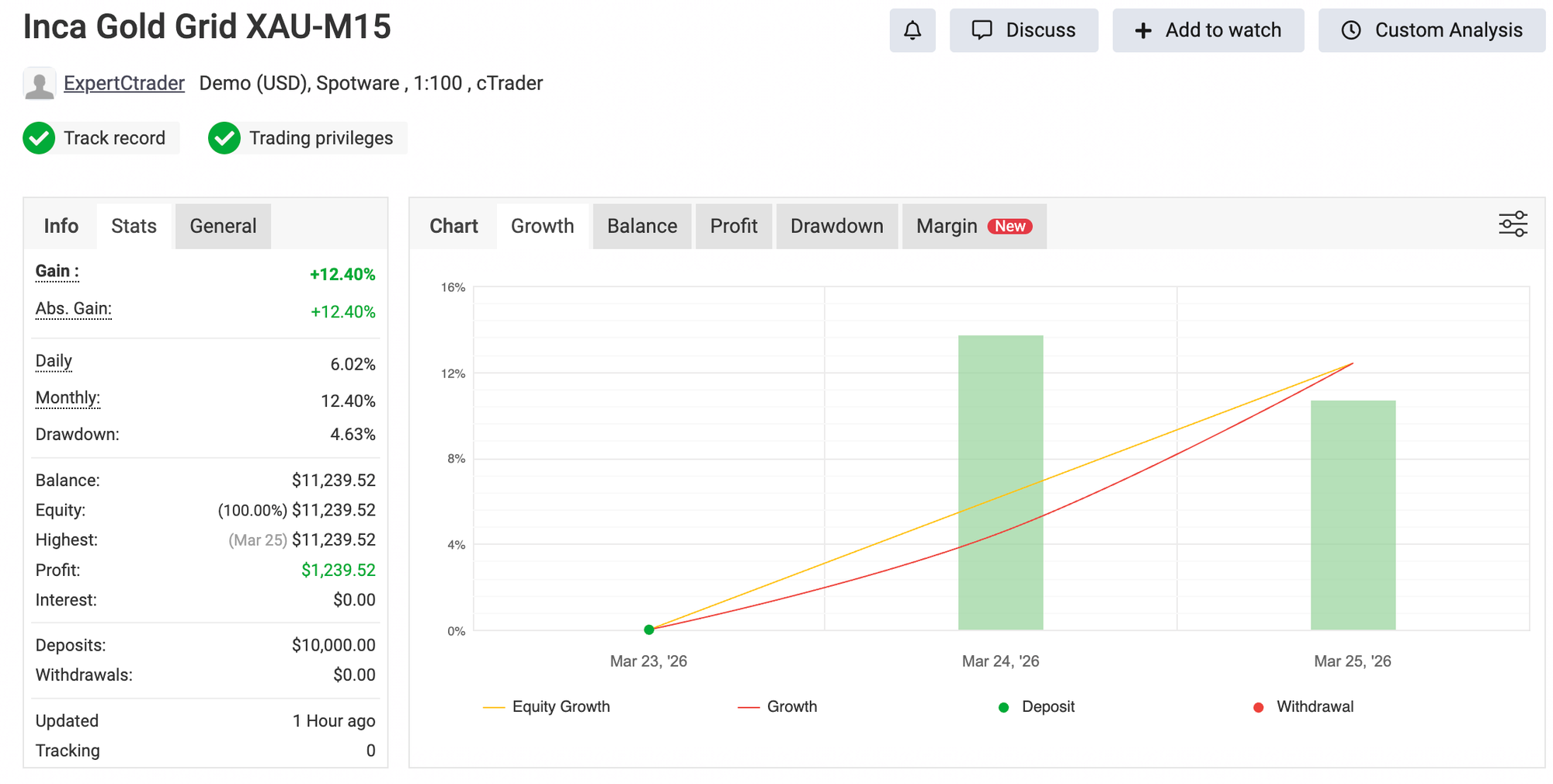
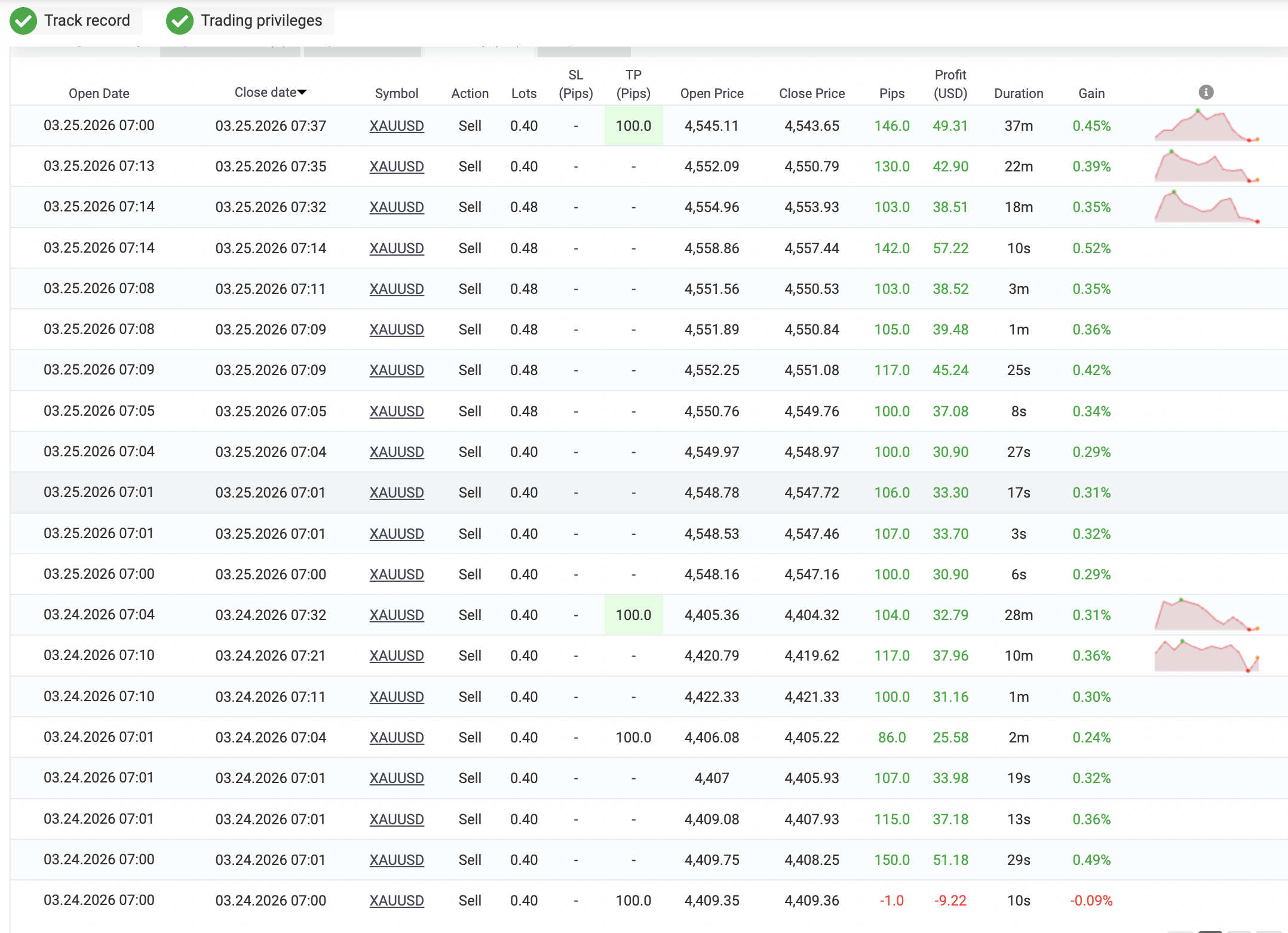
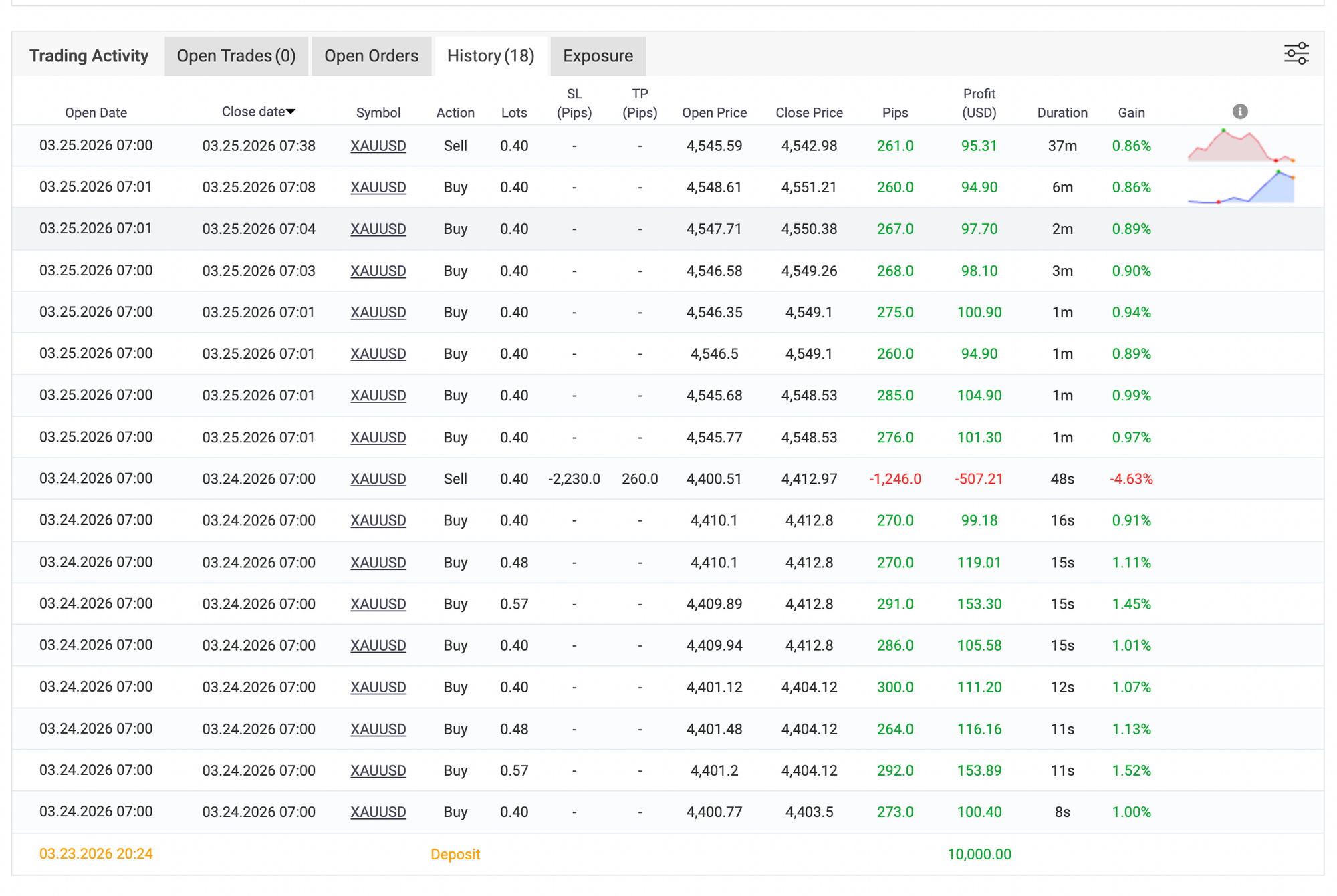
Instead of debating a chart in isolation, we launched optimised versions of the bots on Spotware demo accounts and published the runs on Myfxbook — one of the most popular platforms traders use to track and verify trading results. That gave us something far more useful than a polished historical curve: a live view of how the strategy logic responds to current market stress in real time.
Live results Inca and Maya.
Our Inca and Maya setups. (how to upload)
At the time of writing, the live runs show early positive movement, with Maya and Inca both generating gains in the opening days of observation. That does not prove long-term robustness, and it should not be framed that way. But it does make the exercise worthwhile, because it allows traders to study live reaction rather than relying purely on hindsight.
This is especially relevant for Gold right now.
When the market is being shaped by politics, inflation expectations, rate narratives, and periodic bursts of fear, a strategy’s ability to adapt becomes more important than its ability to look perfect in a static test.
We are sharing the settings — but that is not the point
As part of this article, we are sharing the configuration files used in our own current Maya and Inca runs.
Live results Inca and Maya.
Our Inca and Maya setups. (how to upload)
Some readers will naturally interpret that as “great, now I can use the same setup.”
That is precisely the wrong takeaway.
These files are not meant to be copied blindly. They are meant to be studied.
Think of them as a starting point, not an answer key.
The real value is not in importing someone else’s parameters and hoping for the same result. The real value is in understanding why those settings were chosen, what assumptions they reflect, and how they interact with the conditions of a specific broker and account setup.
That is the difference between using automation seriously and treating it like a lottery ticket.
The uncomfortable truth: the same bot can behave differently on another broker
This is where many traders still underestimate the basics.
A bot is not running in a vacuum. It runs in a broker environment. And broker environments differ.
Spreads differ.
Execution differs.
Session behaviour differs.
Symbol conditions differ.
Even the feel of the same market can differ once all of those variables start interacting.
So yes, you may import the same settings.
But no, that does not mean you are running the same strategy in the same practical conditions.
That is why optimisation matters.
Live results Inca and Maya.
Our Inca and Maya setups. (how to upload)
Final thought
The cTrader Store reaching 2,000+ products and seeing its first seller pass 300 sales is already an important milestone.
But the more interesting story is what this milestone reveals.
It shows that traders are not only buying products. They are forming preferences around strategy types, authors, and trading logic. They are rewarding systems that appear adaptable, trackable, and worth testing further.
That is why Inca and Maya stood out to us.
Not because they make for a simple promotion.
But because they make for a genuinely interesting investigation.
And as Gold continues to react to politics, macro shifts, and volatility shocks, this is exactly the kind of case we want to keep studying.
Live results Inca and Maya.
Our Inca and Maya setups. (how to upload)
Basic 10 rules for working with trading bots.
How to backtest. How to optimize.
- Default settings are rarely the best settings.
Use them only as a starting point, then optimise the bot on a demo account with your broker. - Broker conditions matter.
Spreads, commissions, execution speed, and symbol specifics differ from broker to broker, so always run your own backtests. - Start with demo, not live.
Before risking real money, check how the bot behaves in real market conditions on a demo account. - Gold is highly sensitive to political and macro news.
XAUUSD can become extremely volatile around major headlines, so be extra careful with risk settings. - Disable Gold bots before weekends if needed.
Weekend gaps and unexpected geopolitical events can create dangerous conditions when the market reopens. - A bot is a tool, not a money button.
Even a strong algorithm still requires monitoring, validation, and risk control. - Never copy settings blindly.
Use shared setup files as a reference point, not as a universal solution. - Re-optimise from time to time.
Market conditions change, and a setup that worked well before may need adjustment later. - Use risk you can actually afford.
Grid systems can be effective, but they require disciplined position sizing and capital management. - Watch live behaviour, not just backtests.
A historical curve may look nice, but real confidence comes from forward testing and live observation.
 Aisylu Chanysheva
Comments ()